Drywall Repair in Connellsville, PA
Punched-through holes, split plaster, winter ceiling stains and soaked basement walls, put right and blended so the repair sits in with the rest of the wall.
(724) 603-1592Phone us, then expect a ring back from a drywall pro serving these towns, ready to hear out the damage and price it.
Call 7 days, 7am–9pm
Work starts only after you've okayed a price. See how a job runs, start to finish.
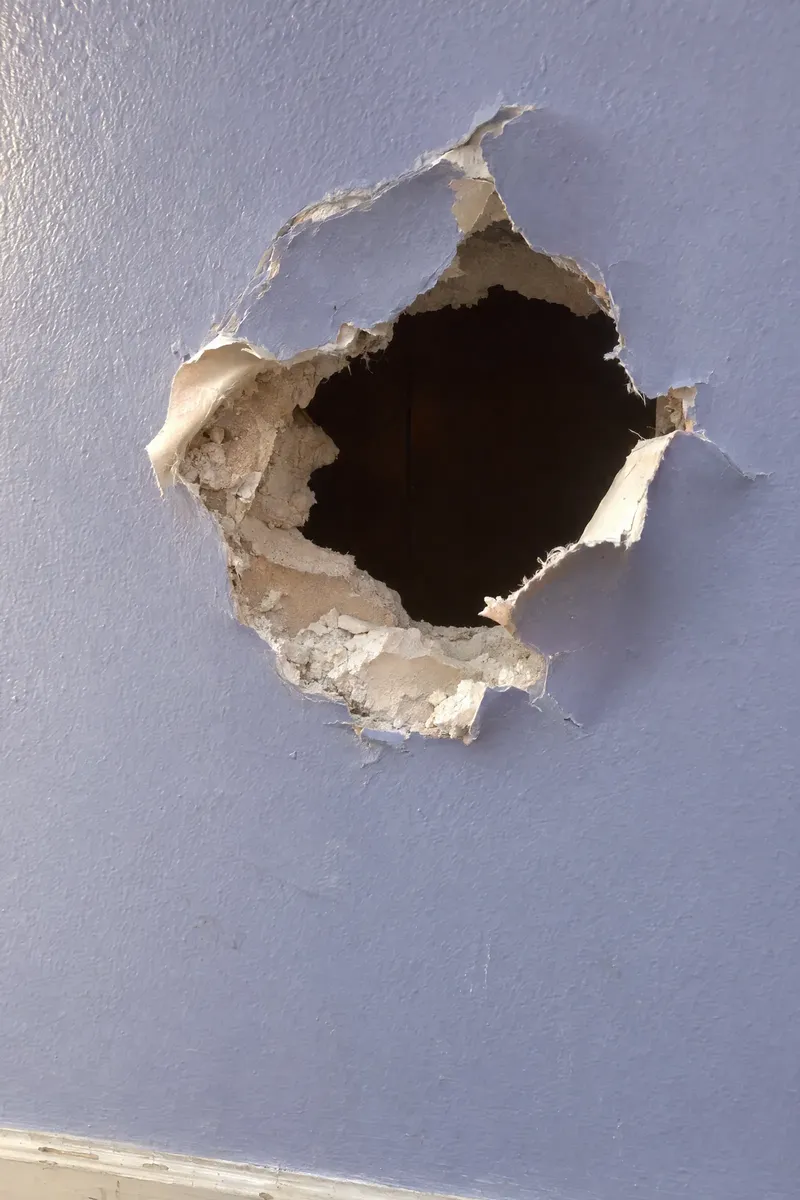
Bigger damage means more coats and drying.
The method barely changes with size. The number of coats, the drying time and the amount of finishing do. Here is how the work scales.
Nail pops, anchor holes, a doorknob dent, a short crack.
Filler or a little backed patch, two skims of mud, sanding and a primer coat. Most of the wait is compound drying between passes.
A fist-size hole, a torn-out TV mount, a seam crack across a ceiling.
Ragged edges get trimmed to a clean rectangle, new gypsum gets fastened onto wood backing, then tape and three passes of mud. Expect it to stretch over two days or more while each pass dries, with texture added at the end where the wall has one.
A sagging ceiling section, a basement flood cut, a wall of loose plaster.
Damaged material comes out, framing is checked for moisture, new board or plaster base goes in, then full taping, a skim and primer. Paint goes on last.
Bob Vila's drywall repair article, drawing on Fixr data, sets a floor of about $75 for a pro to handle a small hole of 4 inches or less, and gives $200 to $550 as a typical spread when one room has multiple holes and cracks. Both are coast-to-coast numbers; neither is a Connellsville rate.
Your own number depends on how many spots there are, how high they sit, whether the wall is plaster or board, what texture has to be copied, and how much priming or painting follows. That number is in your hands before any work begins.
Listing photos catch every bad patch.
Ahead of a landlord's checkout, a closing or the day the real estate photographer shows up, put your effort where a lens or a sharp-eyed buyer will look: pulled TV-mount anchors, knob dents behind doors, cracks above door frames, any ceiling with a ring on it. Hairline paint cracks that a fresh coat will cover can stay off the list.
Sequence matters. The wall repair goes first and the painter second, since fresh mud and primer have to cure under a topcoat. Give us the painter's date or the photo date on the call, and we'll set the work date ahead of it.
Empty houses are the easy ones, and the city has its share: of 3,702 homes tallied in 2020, 14.3% stood vacant. A house between owners or tenants has no furniture to move and no one living with the dust.
Five kinds of wall repair are covered.
From small drywall patching to rebuilt plaster, match what you're seeing to one of these. If the wall has more than one problem, send it all in one request.
Cracked, loose or bulging plaster over wood lath, reattached or rebuilt and skimmed flush with the old wall.
Fine lines, door-corner splits and failed seams, taped across and mudded so they stop ghosting through the paint.
Ceiling stains and soft spots near outside walls after meltwater backs up under the roof edge.
Finished basement walls that took on water: everything below the tide mark stripped out, the cavity dried, fresh sheets hung.
Knob strikes, pulled anchors and torn openings, backed with new board and built back level with the surrounding paint.
Old plaster needs a different repair.
Coal and coke took Connellsville from 1,292 residents in 1870 to 12,845 in 1910. By 2020 the head count was 7,031. If your house goes back to that boom, its walls are most likely plaster over wood lath, not drywall, and that changes how a repair is done.
Those walls hold on by keys, plaster that oozed through the lath and set behind it. Snapped keys mean loose plaster and cracks that track the lath strips. Plaster that's still whole is drawn back tight with screws and thin metal discs; plaster that's crumbling is trimmed to firm edges, filled and skimmed. A drywall insert in a plaster wall needs shimming out to the old depth, or it ends up sitting in a shallow dip.
Old framing settles, too. Diagonal cracks off door corners are normal in a house that age, and a proper repair tapes across them instead of just filling them.
By the EPA's estimate, 87% of houses from before 1940 probably carry lead-based paint somewhere. Old painted plaster shouldn't be sanded or cut until you've asked the pro how they'll keep that dust in check.
More detail: how loose plaster over lath gets repaired.
Electricians and plumbers leave holes behind.
Rewiring an old house means fishing holes in walls and ceilings. A plumber opens a wall to reach a drain. A heating contractor cuts in a new return, and cable or alarm installers leave their own openings. Their job ends when the trade work is done. The wall is left for someone else.
Closing those openings right takes more than a scrap of board. Each opening is trimmed to straight edges, wood cleats go in wherever no stud is handy, and a patch piece gets sized to whatever depth the old wall runs. In a plaster wall, it gets shimmed to depth. Then tape, coats and texture blend it into the wall around it.
If the trade work needs an inspection, leave the opening alone until it's signed off. Closing it early can mean opening it again.
Some damage can wait a season.
Not every mark on a wall is urgent. Water and loose plaster are. Cosmetic damage can wait until it suits you.
Deal with these soon
- A ceiling heavy with water. Kill the breaker serving that ceiling's lights and fan, and only then shoo everyone out from beneath it. Pooled water can tear the board loose.
- Soaked basement board. Wet gypsum left in place is mold food inside the wall. It comes out as soon as the water's shut off.
- Plaster pulling away overhead. Loose ceiling plaster is heavy, and it only falls one way.
- A ring that gets bigger each week. Spread says the leak is live. Find it before anything else.
These can wait
- Hairline cracks that hold still. If a crack isn't widening, it can wait for the next time you paint.
- Nail pops and small dents. Cosmetic only. Batch them with other work.
- An old, dry stain from a fixed leak. Once the board reads dry, it's a seal-and-paint job on your schedule.
- Openings left by another trade. Close them when the trade is done and any inspection is signed off.
Water in a wall calls for a plan.
Most leak damage gets worse because the steps happen in the wrong order: a ceiling patched before the roof is fixed, a basement wall closed up while the studs are still wet. Our guide walks through the right order, from stopping the water to deciding what gets cut out.
Record the mess before you mop it.
The record might go to an adjuster, a property owner or just your own files. Either way, the first hour's photos carry the most weight. Get these before anything is moved, dried or thrown out:
- One shot from the doorway showing the whole room.
- Close detail shots, a ruler lying in frame for size.
- The source: the pipe, the roof edge, the window or the floor drain.
- The date and time on every photo, and a short written note of what happened.
- A new photo each day while things dry, so any spread is on record.
- Damaged belongings, before anything goes to the curb.
- Receipts for fans, dehumidifier rental or emergency plumbing.
We don't weigh in on coverage or lease terms. A tidy, dated record simply gives you something solid to hand over.
Five wall repair beliefs are wrong.
- Spackle fixes any hole.
- Lightweight spackle is for nail holes. Anything past a couple of inches needs backing and joint compound or it cracks out.
- Paint hides a water stain.
- Latex paint lets a brown ring creep right back. It needs a stain sealer under it, and that only happens once the drip is cured and the board has dried out.
- Cracked plaster has to be torn out.
- Plaster that can be reattached is usually repaired in place. Tearing out means more dust, more trim work and a bigger bill.
- A stain that dried is finished.
- A dry stain can mean a leak that only runs in certain weather, like an ice dam or wind-driven rain. Find the source before the patch.
- Any patch works on a plaster wall.
- Half-inch board is rarely as thick as old plaster. Without shims or extra build-up, it ends up recessed below the wall around it.
Six boroughs and towns sit close by.
We take calls from Connellsville on both sides of the Youghiogheny and from the boroughs and towns nearby, in Fayette and Westmoreland counties.
- South Connellsville, south of the city
- Dunbar, south-southwest of the city
- Uniontown, southwest of the city
- Vanderbilt, west-northwest of the city
- Scottdale, north of the city
- Mount Pleasant, north-northeast of the city
Short notes on each one sit on the page listing every town on our service list.
Landlords can batch rooms into one job.
Turnovers are where wall damage piles up. A few habits keep a unit from sitting empty longer than it has to:
- Do one pass through the unit with your phone camera, wall by wall, and send everything in a single request.
- Batch rooms. One booking for six holes beats six bookings for one.
- Settle keys or a lockbox code on that first phone call so access doesn't hold up the work date.
- With a tenant in place, give the notice your lease requires before the work date.
- Schedule the wall repair ahead of the painter, leaving the mud and primer time to cure.
- File the pictures and the quote with the security deposit paperwork; together they show what was fixed and why.
Start with a few lines about the wall.
Two or three sentences and a rough measurement will do. Say plaster or drywall if you can tell, and say so if water had a hand in it.
(724) 603-1592
Call 7 days, 7am–9pm
Make the call, and a nearby pro returns it to hash out the wall and price the work.
Once it's in, a drywall contractor covering your town rings you, goes over the wall and puts a quote together.